Presence, Ritual and Consumption by Adrian Fisher and Luna Montenegro
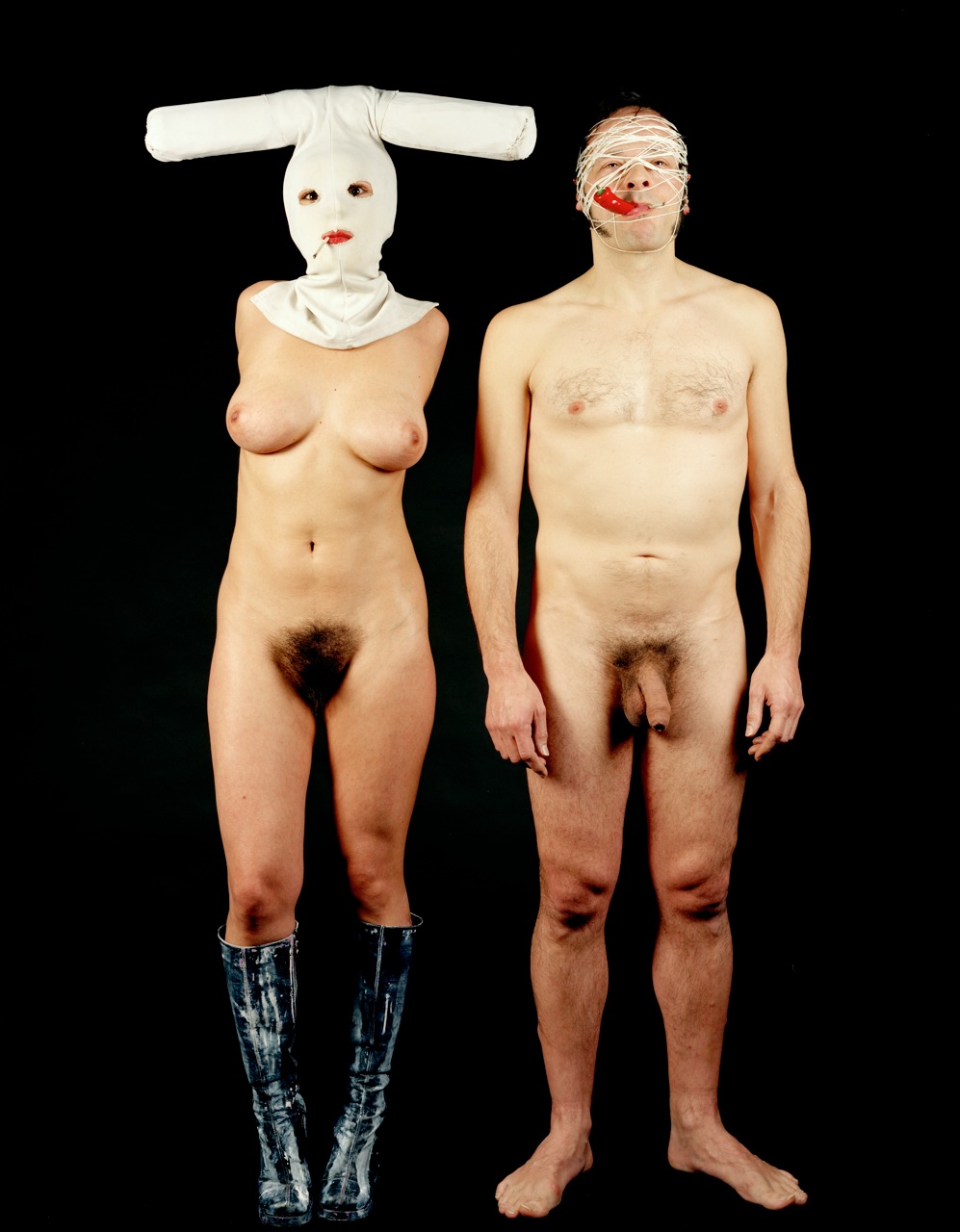
‘between what is described and what is inscribed' (edition of 3) giclée print on archival paper. 425mm x 535mm x 45mm (framed).Concept by mmmmm . Camera: Ignacio Acosta. mmmmm 2009, London, UK.
We have been working together since january 2000 in a joint desire to make live and time-based artworks that put ‘presence’ at the forefront of the work.
The content of the work maintains a ritualistic form that explores contemporary objects, technology and actions in the context of ancient traditions and indigenous beliefs.
Our practice leads us from research into making live unique performance actions exploring ideas of the body, to how these events can then be registered with the ‘presence’ of the action, in digital photography, painting, objects and film.
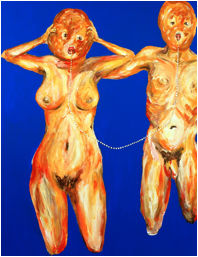
study from Gift . acrylic paint on canvas (400mm x 500mm).mmmmm 2008, London, UK.
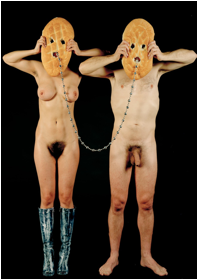
‘Gift' Relic I (edition of 3) giclée print on archival paper. 425mm x 535mm x 45mm (framed). Concept by mmmmm . Camera: Ignacio Acosta. mmmmm 2009, London, UK.
We created the project name ‘mmmmm’ in 2001 for making time-based work in a partnership. This work may also lead us to working with up to 50 people in the production of specific event or curating visual art shows.
'OSH' is a fertility ritual made by mmmmm in a former Power Station (Berlin, Germany August 2003). It was inspired from the now extinct ‘Selk’nam’ (indigenous people of Tierra del Fuego southern Chile). The original ritual ‘Oshkonhaninh’, was a phallic ritual in which the women of the group made tails from bull rushes for the men to use as substitute penises. The men formed a circle and slowly rotated chanting ‘xas’, the sound and speed of rotation reached a crescendo until finally the men’s heads lowered and their tales rose up creating a visual group erection.
In our re-working of this ritual we cycled naked around the streets of the Power Station neighborhood (Kreuzberg) chanting ‘xas’. We then used a 5000 Kg crane to pass a cigarette, a toothbrush and a chili pepper between us. The negotiation and use of these objects together with artifacts from the original Selk’nam ritual are fused to create a mutated hybrid contemporary ritual.
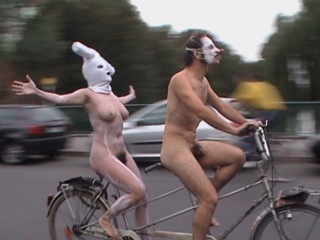
digital image from video. OSH (18 mins) edition of 50, dvd. mmmmm 2004.

digital image from video.OSH (18 mins) edition of 50, dvd. mmmmm 2004.
The everyday objects in the ritual are transformed into icons of our contemporary ritual, the mass produced becomes unique through this process and changes our relation towards mass consumption. It is an attempt to put the ‘aura’ (1) back into the artwork.
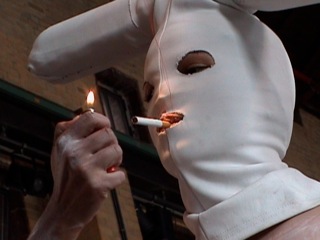
digital image from video. OSH (18 mins) edition of 50, dvd. mmmmm 2004.
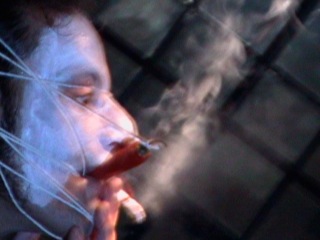
OSH (relic I) (edition of 5). giclée print on archival paper. 297mm x 210mm (unframed). mmmmm 2005.
In the film OSH (18mins DVD) a red chili pepper swings gently against the female artists’ vagina to the text of the last surviving Selk’nam Shaman, Lola Kiepja.
The chilli is ‘Chile’ as defined by the shape of the geographical borders of the country. It is also red in relation to the most valued commodity of desire for the Selk’nam people (land would be traded to the colonialists in exchange for red objects and materials).
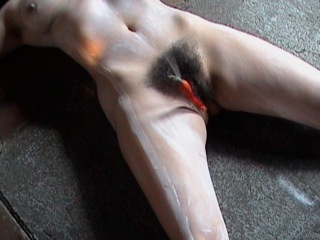
digital image from video. OSH (18 mins) edition of 50, dvd. mmmmm 2004
In a psychoanalytic sense it serves as the maternal phallus (2) in the eye of the onlooker, it reminds the fetishist of his own castration in the way that the colonialists destroyed the Selk’nam people in their own pathological commodity fetishism of land and property.
The process of re-evaluating the mass-produced, of embedding it with different times and contexts through actions and relations to the body forms the basis of our investigations into excess and consumption. It is in this process of transforming the mass-produced into a unique totemic object that the presence of the body becomes apparent.
In ‘A True Likeness of…’ (ICA, London Sept 2005) the focal object of the transformation ritual was a domestic ‘paper shredder.’
The statement, ‘I certify that this image is a true likeness of…’ is required to be written on the back of a photograph to validate an individual when applying for an official document, such as a Passport. The reduction to a series of words, a mantra of identity, a ritualistic repetition in the symbolic, leads the state to validate that the photographic image is a true representation of the individual applying.
In our live artwork a rolled up map of the world is taken from between the legs of one of the artists and put through a shredding machine that is held high above another artist’s naked body. The shredder and the body appear to form a new ‘machine’ a cyborg. The symbolic is fractured into a poetic snow that falls over and sticks to the body as it attempts to subjugate and identify.
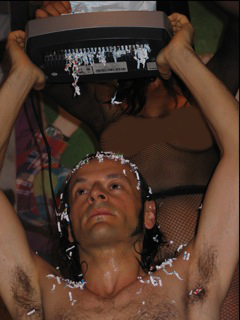
digital image from live video of performance. 10/09/05 '... a true likeness of...' at The Institute of Contemporary Art, ICA, London, mmmmm 2005.
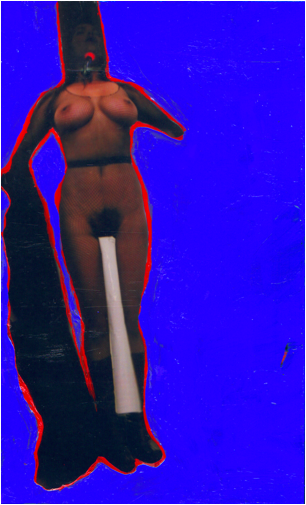
‘A True Likeness Of…’ Relic I (edition of 5) giclée print on archival paper. 210mm x 297mm (unframed). mmmmm 2005.
The relation between the organic and inorganic, the machines that process the streams of information and evaluate desire were also the subject of another performance ‘Fucking Hardware’ at The Curwin Gallery, London 2004.
.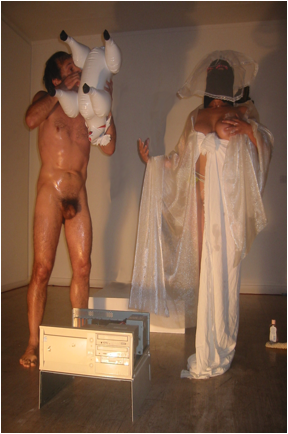
‘fucking hardware’ Relic I (Edition of 5) giclée print on archival paper. 210mm x 297mm (unframed). mmmmm 2004.
A Personal computer was seduced with baby oil and ritualistically married to a virgin bride. From inside the computer case a sex toy sheep was taken and inflated. Yhe bride takes an egg from the sheep's anus. The computer was switched on and the bride broke the egg on the motherboard. The relation between linguistics and the object slips between forms. The organic egg, the bride, the oil, serves to collide with the presence of the hardware, the mass produced computer and sex toys. The organic and inorganic crash with each other as the computer continues to run while the egg slowly begins to fry fusing with the motherboard.
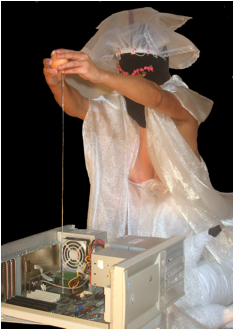
‘fucking hardware’ Relic II (Edition of 5) giclée print on archival paper. 210mm x 297mm (unframed). mmmmm 2004.
There is a tension between the symbolic naming of the inorganic hardware and a desire through language, through the ritual of naming, to make the inorganic somehow present and relevant to the organic. At one level this desire is shown through the Internet as a vehicle for the dissemination of pornography. In our live action the hardware is fucked both fetishistically and at a base level, it begins to malfunction. The naming of the inorganic, the integrated circuits as motherboard, collapses with the real organic, the symbolic birth of life, the mythical Dogon egg (3), as it smashes on the nerve centre controller of the computer, momentarily both objects transform, the egg solidifies, the computer begins to short circuit.
Our work together also attempts a re-configuration of anthropology through its live art works. The re-construction of rituals from extinct or genocided cultures such as the Selk’nam in Chile form a political imperative. The investigation of their rituals through visiting their former nomadic lands and the gathering of information described by visiting missionaries and anthropologists, are part of the process for making the ‘absent’, ‘present’. It is part of the challenge of the work to re-think these constructions of subjectivity, and this in itself becomes a ritual.
In our work ‘Xalpen’ (London 2006) for the launch of ‘Naked Punch’ Review Journal of Contemporary Art and Thought, we developed the mythological character of Xalpen, the earth spirit from the Selk’nam culture. She is said to have an insatiable desire for food and sex and is prone to rage, the tribe must satisfy her. In the original ritual the mythical Xalpen fills the adolescent males ‘Kloctens’ (4) in the rites of passage ceremony, with semen so that their scrotums expand enormously. In a sense she is the ‘libidinal economy’, she is the consuming machine, she is in terms of Lyotard (5) ‘the event that contains more possibilities for interpretation and exploitation than any single structure can give her.’ In our re-working of this ritual she is replaced by an artist wearing a safety jacket who inflates the earth with a pump as his penis. A form of masturbation, a closed circle of desire, Xalpen demands more and more, inflating the earth to the verge of an explosion of desire.
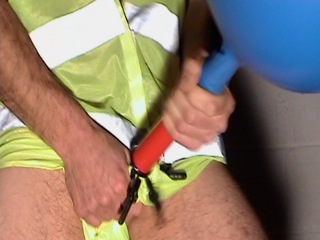
digital image from live video of performance. 03.12.06 'Xalpen' (Selk'nam IV from The Selk'nam rituals, Tierra del Fuego) The Brick House, Old Trumans Brewery, 91 Brick Lane, London, UK. mmmmm 2006.
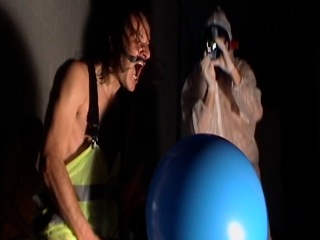
digital image from live video of performance. 03.12.06 'Xalpen' (Selk'nam IV from The Selk'nam rituals, Tierra del Fuego) The Brick House, Old Trumans Brewery, 91 Brick Lane, London, UK. mmmmm 2006.
In another part of the same live work Xalpen becomes a dog speaking into short wave radios, repeating ‘Tony’s dog’ referring to the Chilean term for a clown, a ‘Tony’ and to the current uk political leader. Locked in a loop of repetition the short wave radios begin to feedback on each other distorting the sound with interference. Technology begins to breakdown, the organic, the body, reappears.
All of our unique live works are documented in digital video, together with photography. Through a process of editing, digital manipulation and painting the documentation is transformed into new lens-based artworks that challenge the presence of the body in their respective medium.
The documenter is also present inside the ritual. The photographer is dressed in a forensic science suit integrated into the artwork. He makes a subjectivity, an intimacy, and a distinct position within the work. His point of view is as the artist investigating the artifice. At the same time he is inside and outside the ritual. This blurring of the forms implies the question; what is mediated where? The photographer becomes the documenter of his own actions. He views the actions from points of view the public cannot see. In the last part of the ritual Xalpen the photographer’s point of view is from the floor upwards, through the genitals, 8 popadoms are compressed between the naked artists, the photographer catches the falling crispy pieces as they flake and crisp over the camera.
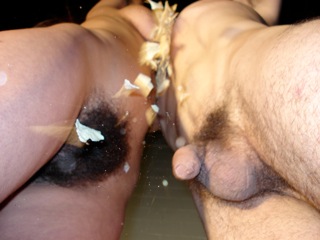
digital photograph by Gines Olivares. 03.12.06 'Xalpen' (Selk'nam IV from The Selk'nam rituals, Tierra del Fuego) The Brick House, Old Trumans Brewery, 91 Brick Lane, London, UK. mmmmm 2006.
The examination of process in registering ‘presence’ was further developed in a work we made in Berlin in a former bread-making factory. ‘Gift’ (Backfabrik 2003) Title taken from Heidegger’s essay on ‘The Thing’ (6)
'In the Gift of the outpouring dwells the singlefoldness of the four’.
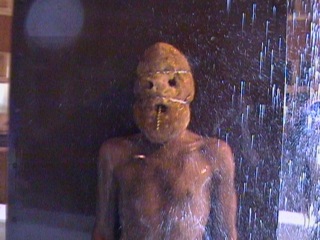
digital image from edited video of live performance. GIFT (8 mins) edition of 5, dvd. mmmmm 2004
Heidegger refers to the ‘four’ as sky, earth, mortals and divinities. In his writings on the ‘jug’ it is the action of pouring which makes the ‘jug’ a thing, in our live work we stand under a fountain in the courtyard of a bread factory at the four cardinal points. The cameraman takes a string of pearls from the mouth of one of the artists. As he pulls the pearls with his fingers tight to the camera lens the ‘body’ becomes the thing. It is the digital tape inside the video camera that defines the body and gives it its ‘thingness’. The work also continues the themes of identity and consumption. The artists have masks made from Turkish bread that dissolve under the flow of water from the fountain. Their re-contextualization in a former German bread factory emphasizes the new immigrant work force, ‘guestworker’ and its relation to the basic commodity of bread.
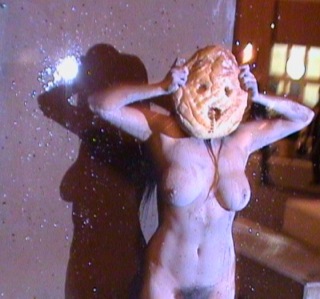
digital image from edited video of live performance. GIFT (8 mins) edition of 5, dvd. mmmmm 2004
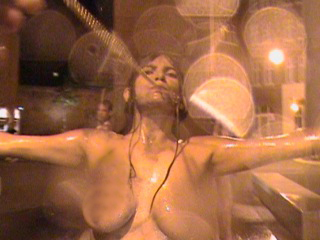
digital image from edited video of live performance. GIFT (8 mins) edition of 5, dvd. mmmmm 2004
We continue to investigate these ideas of presence, ritual and consumption. Through transforming the object, through blurring the organic and inorganic and by examining the surface of commodity fetishism, the body becomes present.
Notes
1. Walter Benjamin (1936) - The Work of Art in the Age of Mechanical Reproduction, in ‘Illuminations’, Fontana Press, London 1992.
2. Sigmund Freud, Fetishism (1927) ‘On Sexuality’, Penguin Books, London. 1991
3. Gilles Deleuze/Félix Guattari, ‘How to make a Body without Organs?’ A Thousand Plateaus. Capitalism and schizophrenia, Athlone Press Ltd, 1996.
4. Anne Chapman, Drama and Power in a Hunting Society. The Selk’nam of Tierra del Fuego. Cambridge University Press, Cambridge, UK. 1982.
5. Jean-François Lyotard, ‘Libidinal Economy’. trans. Iain Hamilton Grant, Athlone, London, 1993).
6. Heidegger, The Thing in Poetry, Language and Thought. A. Hofstadter trans. Harper and Row, New York, 1971